
DORIAN
Driving Increased Retention for UGC Games
My Role
User Research
Product Design
Visual Design & Animation
Tools
Figma
The Core Team
VP of Content
VP of Marketing
Director of PM
VP of Engineering
Overview
Dorian is a UGC game platform where any creator can publish and monetize their narrative games. The product consists of both a standalone app (iOS/Android/Windows) and a desktop web game creation tool.
The product had a great library of creator content and excelled at monetization, but as Director of Product Design, I was tasked with improving our early fan retention. Too many new users weren’t engaging with the content.
Defining the Problem
My first action was to better understand what was preventing new users from retaining better. I ran regular, rolling FTUE play tests to identify key friction points in our D1 experience.
In conjunction, I personally conducted 30-minute 1:1 interviews with our most engaged users to better understand what they loved about the product - and how we might be able to better build upon those strengths to appeal to new users.
New users churned because:
The costs are viewed as too high and they don’t have any way to earn free currency
Don’t understand what they’re working towards
Engaged users stayed because:
They liked the sense of building a relationship with characters
They liked feeling like their choices in the game mattered
Solutions
Economy
Though our monetization was strong, the product was viewed as "too expensive" for many new users. Since the product had a revenue share model with creators, it was not possible for us to distribute large amounts of free currency like similar standalone games. We needed a different kind of solution.
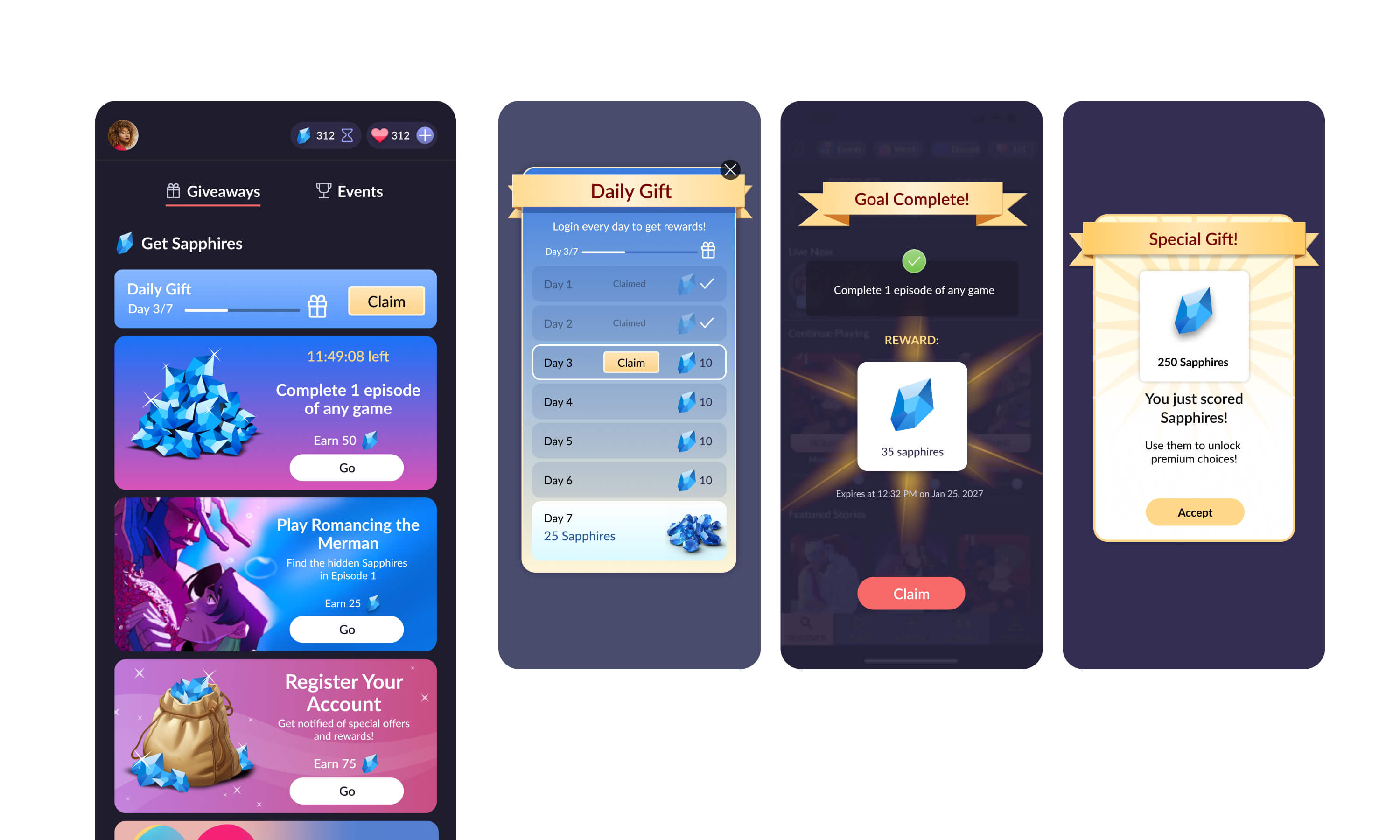
I led the development of a new platform-level-only currency type (Sapphires), which could be used to provide new users with a sense of reward without affecting negatively affecting our creator monetization. We added a streak mechanic and a new Rewards screen to incentivize engagement for early reward.
Goals System
Many of the games on the Dorian platform are dating sims, and a common player request in interviews was the desire to track their progress building relationships with game characters. The data also backed up that fans who engaged with characters in this way showed deeper engagement. From these signals, we saw an opportunity to deepen fan retention and engagement by creating a goal system that any creator could add to their games. I designed the progression system, iterating heavily in mocks and Figma prototypes, then overseeing execution and optimization of the final design. The process included heavy AB testing and user feedback with each rollout.
The Timeline screen
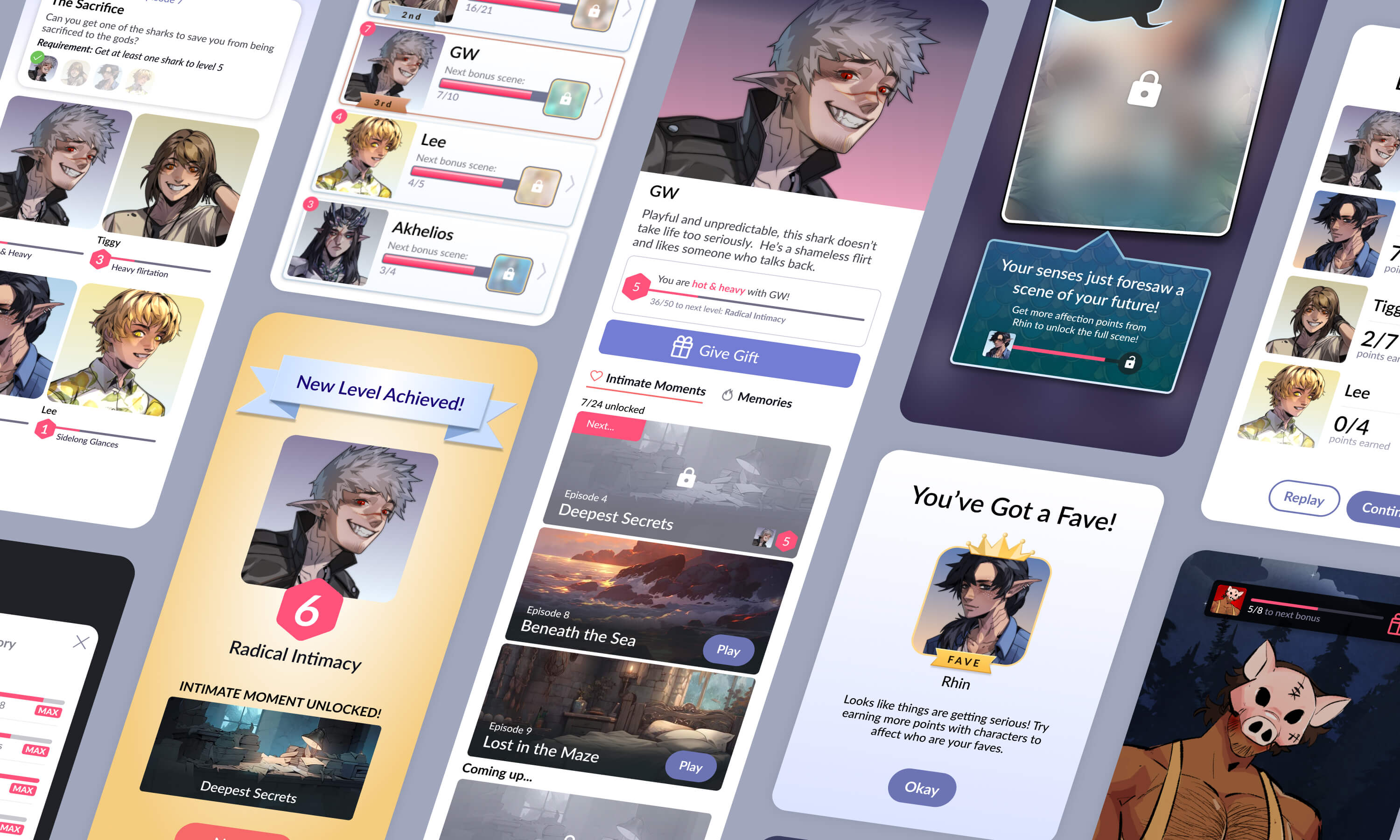
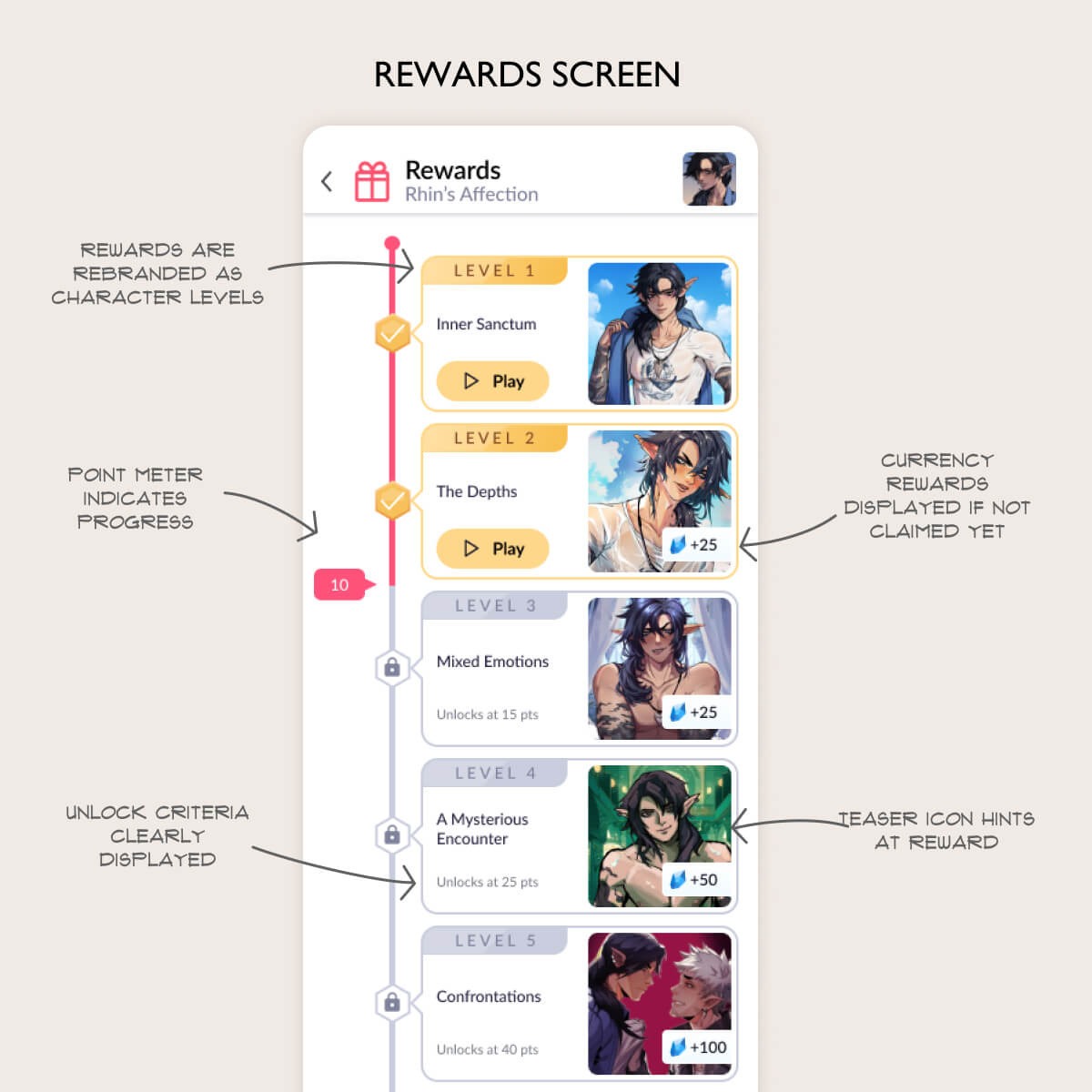
One of the key components of the progression system was a new Timeline Screen, where users track their progress towards all goals and rewards.
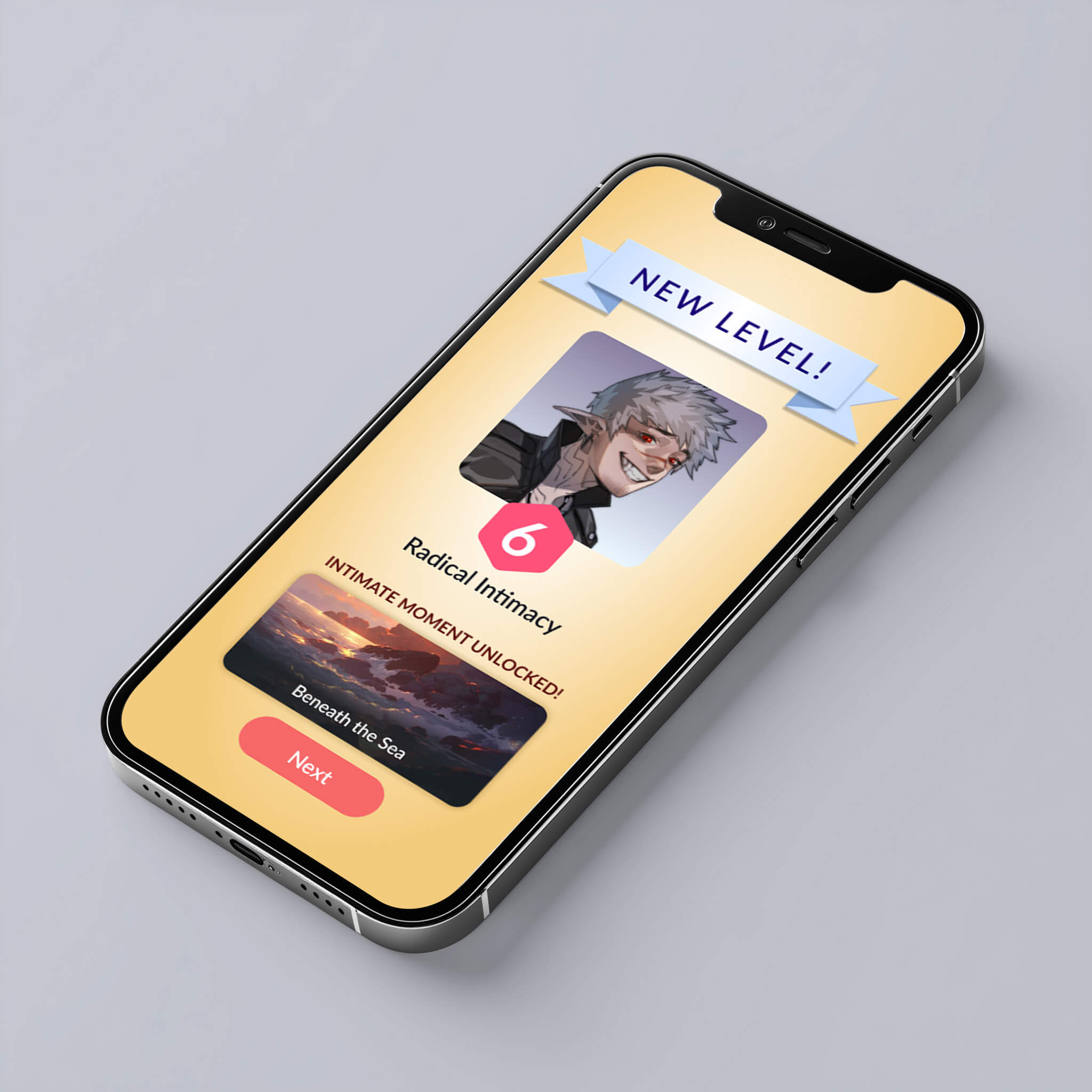
Rewards were branded as character level-ups, building off the idea that players were deepening their relationships with the love interests. I also added more animated level-up moments to increase the sense of reward for new players.
New Game HUD and Episode Summary
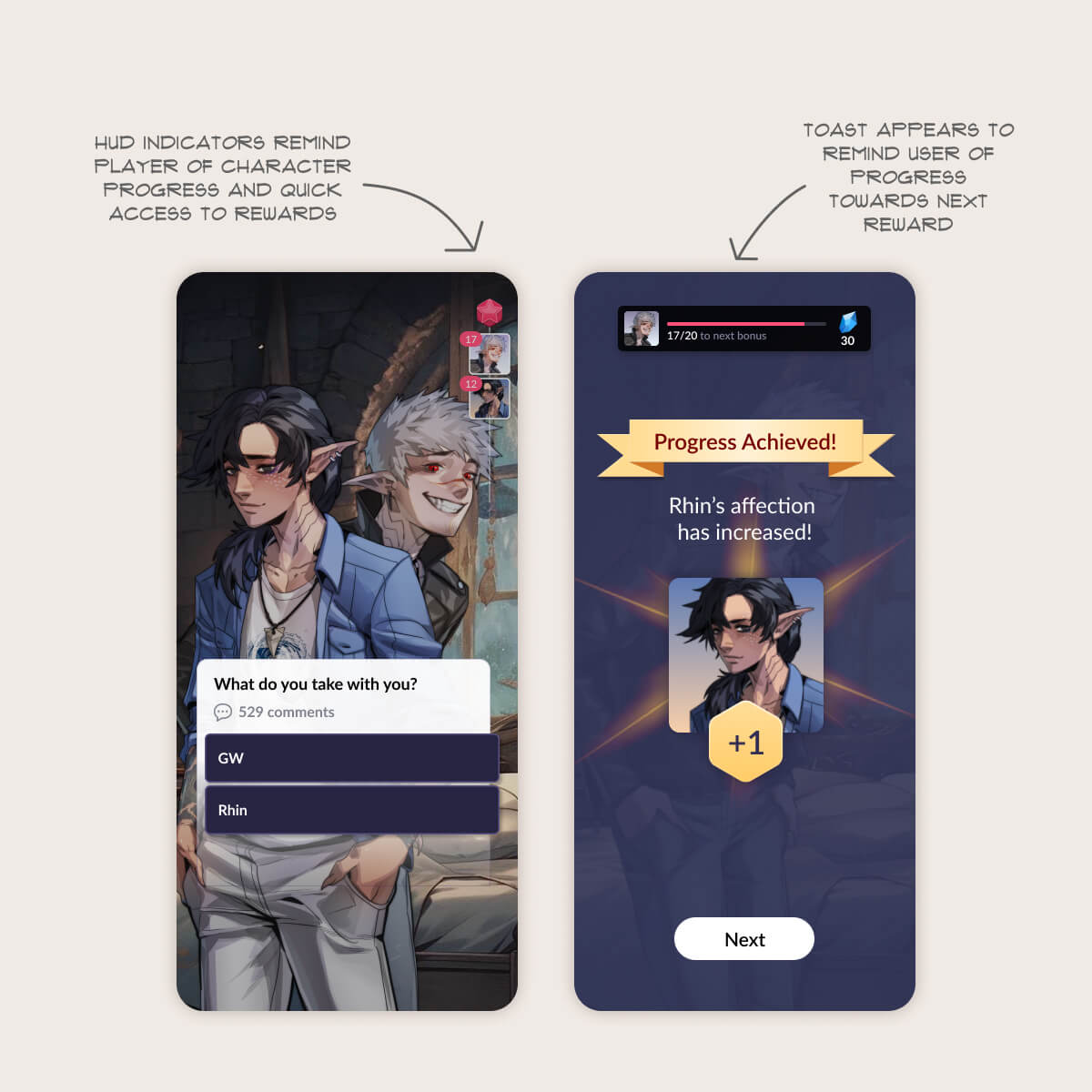
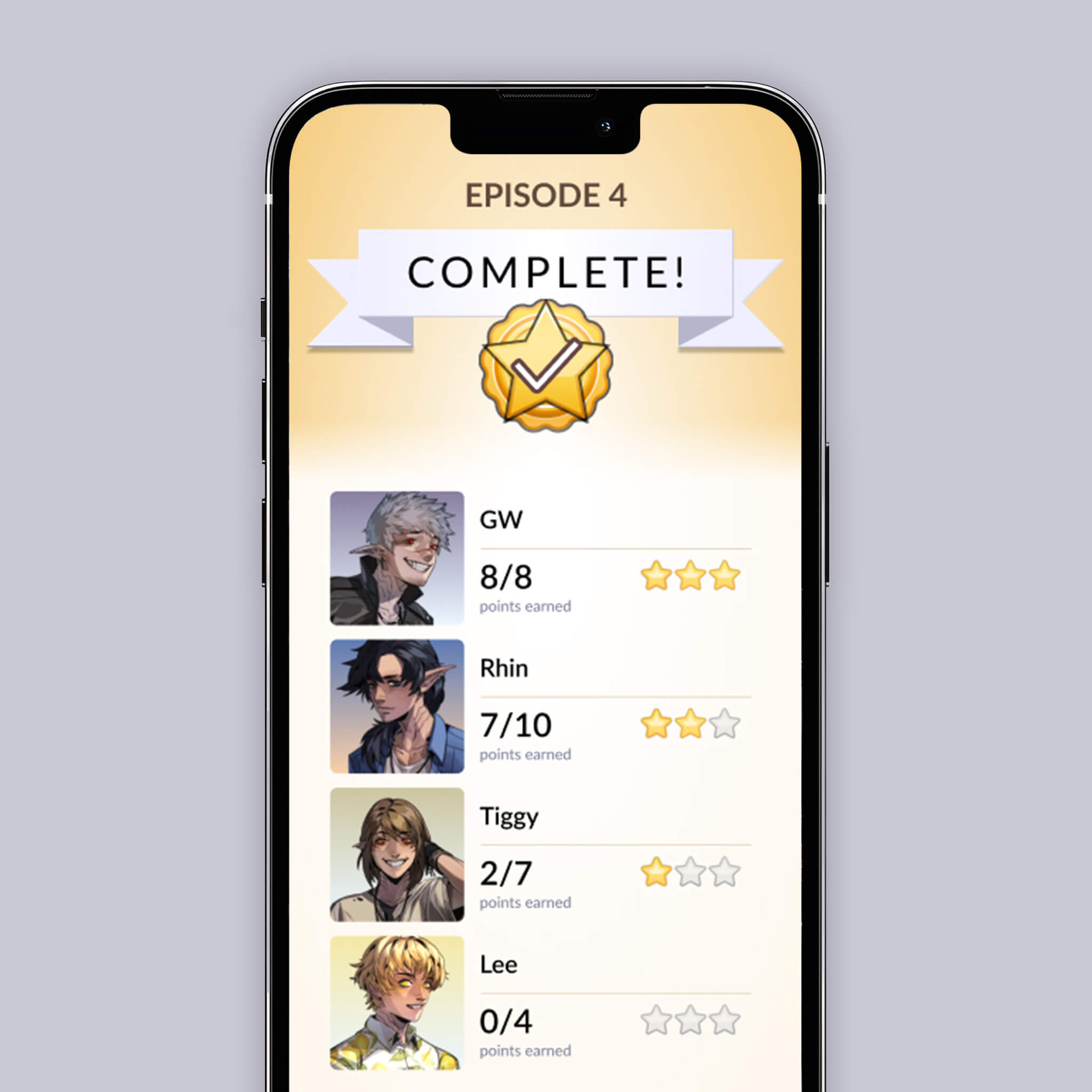
Engaged players told us they liked knowing if they found all points in a game episode, so I designed an Episode Summary Screen which led to increased level replay. I also revamped our outdated game HUD to provide players with easy access to goals, with animated icons and progress toasts to draw the eye.
Results & Next Steps
We released an MVP of the feature and saw over 20% increased D7 retention on the games that were utilizing the new system. This gave us the confidence to expand the feature with several new enhancements and sub-features.


DORIAN
Driving Increased Retention for UGC Games
My Role
User Research
Product Design
Visual Design & Animation
Tools
Figma
The Core Team
VP of Content
VP of Marketing
Director of PM
VP of Engineering
Overview
Dorian is a UGC game platform where any creator can publish and monetize their narrative games. The product consists of both a standalone app (iOS/Android/Windows) and a desktop web game creation tool.
The product had a great library of creator content and excelled at monetization, but as Director of Product Design, I was tasked with improving our early fan retention. Too many new users weren’t engaging with the content.
Defining the Problem
My first action was to better understand what was preventing new users from retaining better. I ran regular, rolling FTUE play tests to identify key friction points in our D1 experience.
In conjunction, I personally conducted 30-minute 1:1 interviews with our most engaged users to better understand what they loved about the product - and how we might be able to better build upon those strengths to appeal to new users.
New users churned because:
The costs are viewed as too high and they don’t have any way to earn free currency
Don’t understand what they’re working towards
Engaged users stayed because:
They liked the sense of building a relationship with characters
They liked feeling like their choices in the game mattered
Solutions
Economy
Though our monetization was strong, the product was viewed as "too expensive" for many new users. Since the product had a revenue share model with creators, it was not possible for us to distribute large amounts of free currency like similar standalone games. We needed a different kind of solution.
I led the development of a new platform-level-only currency type (Sapphires), which could be used to provide new users with a sense of reward without affecting negatively affecting our creator monetization. We added a streak mechanic and a new Rewards screen to incentivize engagement for early reward.
Goals System
Many of the games on the Dorian platform are dating sims, and a common player request in interviews was the desire to track their progress building relationships with game characters. The data also backed up that fans who engaged with characters in this way showed deeper engagement. From these signals, we saw an opportunity to deepen fan retention and engagement by creating a goal system that any creator could add to their games. I designed the progression system, iterating heavily in mocks and Figma prototypes, then overseeing execution and optimization of the final design. The process included heavy AB testing and user feedback with each rollout.
The Timeline screen
One of the key components of the progression system was a new Timeline Screen, where users track their progress towards all goals and rewards.
Rewards were branded as character level-ups, building off the idea that players were deepening their relationships with the love interests. I also added more animated level-up moments to increase the sense of reward for new players.
New Game HUD and Episode Summary
Engaged players told us they liked knowing if they found all points in a game episode, so I designed an Episode Summary Screen which led to increased level replay. I also revamped our outdated game HUD to provide players with easy access to goals, with animated icons and progress toasts to draw the eye.
Results & Next Steps
We released an MVP of the feature and saw over 20% increased D7 retention on the games that were utilizing the new system. This gave us the confidence to expand the feature with several new enhancements and sub-features.
DORIAN
Driving Increased Retention for UGC Games
My Role
User Research
Product Design
Visual Design & Animation
Tools
Figma
The Core Team
VP of Content
VP of Marketing
Director of PM
VP of Engineering
Overview
Dorian is a UGC game platform where any creator can publish and monetize their narrative games. The product consists of both a standalone app (iOS/Android/Windows) and a desktop web game creation tool.
The product had a great library of creator content and excelled at monetization, but as Director of Product Design, I was tasked with improving our early fan retention. Too many new users weren’t engaging with the content.
Defining the Problem
My first action was to better understand what was preventing new users from retaining better. I ran regular, rolling FTUE play tests to identify key friction points in our D1 experience.
In conjunction, I personally conducted 30-minute 1:1 interviews with our most engaged users to better understand what they loved about the product - and how we might be able to better build upon those strengths to appeal to new users.
New users churned because:
The costs are viewed as too high and they don’t have any way to earn free currency
Don’t understand what they’re working towards
Engaged users stayed because:
They liked the sense of building a relationship with characters
They liked feeling like their choices in the game mattered
Solutions
Economy
Though our monetization was strong, the product was viewed as "too expensive" for many new users. Since the product had a revenue share model with creators, it was not possible for us to distribute large amounts of free currency like similar standalone games. We needed a different kind of solution.
I led the development of a new platform-level-only currency type (Sapphires), which could be used to provide new users with a sense of reward without affecting negatively affecting our creator monetization. We added a streak mechanic and a new Rewards screen to incentivize engagement for early reward.
Goals System
Many of the games on the Dorian platform are dating sims, and a common player request in interviews was the desire to track their progress building relationships with game characters. The data also backed up that fans who engaged with characters in this way showed deeper engagement. From these signals, we saw an opportunity to deepen fan retention and engagement by creating a goal system that any creator could add to their games. I designed the progression system, iterating heavily in mocks and Figma prototypes, then overseeing execution and optimization of the final design. The process included heavy AB testing and user feedback with each rollout.
The Timeline screen
One of the key components of the progression system was a new Timeline Screen, where users track their progress towards all goals and rewards.
Rewards were branded as character level-ups, building off the idea that players were deepening their relationships with the love interests. I also added more animated level-up moments to increase the sense of reward for new players.
New Game HUD and Episode Summary
Engaged players told us they liked knowing if they found all points in a game episode, so I designed an Episode Summary Screen which led to increased level replay. I also revamped our outdated game HUD to provide players with easy access to goals, with animated icons and progress toasts to draw the eye.
Results & Next Steps
We released an MVP of the feature and saw over 20% increased D7 retention on the games that were utilizing the new system. This gave us the confidence to expand the feature with several new enhancements and sub-features.